
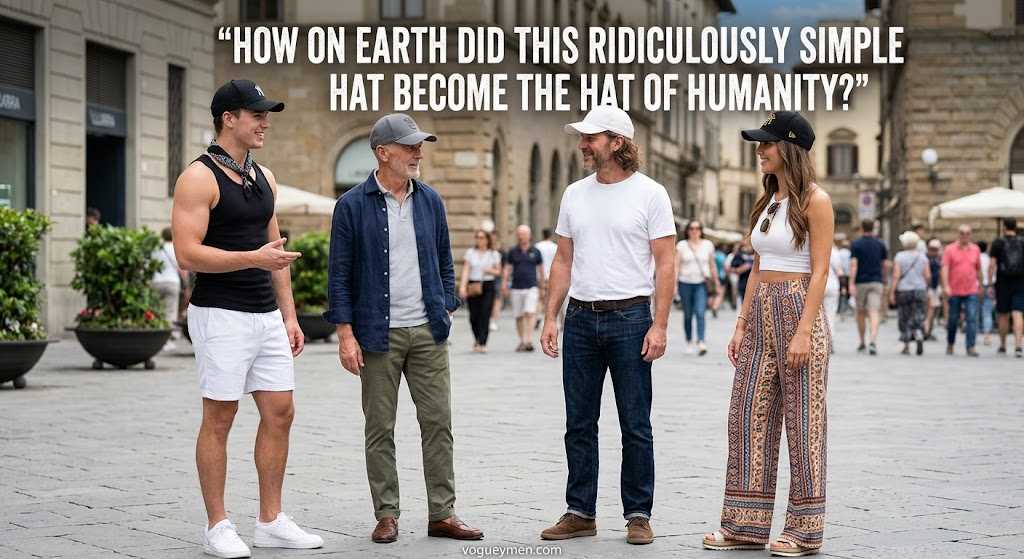
There are hats that belong to a place, a profession or a particular era. The cowboy hat belongs to the American West. The beret has its European (and Argentinian) associations. The trilby, the Fedora, Akubra, kufi and the Gat all carry cultural histories far deeper than fashion.
And then there is the baseball cap.
It is remarkably difficult to find another piece of headwear that has travelled so far, crossed so many cultural boundaries and been adopted by so many different kinds of people. A teenager in Seoul, a football supporter in Manchester, a cricket fan in India, a rapper in New York, a tourist in Paris and a billionaire on a yacht can all reach for essentially the same thing: a crown, a curved or flat visor and, quite possibly, somebody’s logo embroidered on the front.
The numbers tell the story. Baseball-cap sales have reached hundreds of millions of units in major markets, while individual manufacturers have sold tens of millions of caps a year. In the United States alone, historical industry estimates have put annual baseball-cap sales in the hundreds of millions. No fedora, cowboy hat or fashionable knit beanie has come remotely close to matching that combination of sales, ubiquity and everyday use.
So how did a piece of American sporting headwear become the unofficial hat of humanity?
From baseball field to everyday life
The baseball cap did not arrive fully formed from some brilliant fashion designer’s sketchbook. Its ancestors were practical sporting headwear.
The New York Knickerbockers were already wearing hats in the 1840s, while by the late 1850s and 1860s teams such as the Brooklyn Excelsiors were wearing something much closer to what we recognise today: a rounded crown with a forward-facing bill. The design was simple and sensible. The visor helped shield players’ eyes from the sun, while the cap stayed relatively secure during vigorous movement.
The baseball cap was therefore born with an advantage that many fashion items spend decades trying to acquire:
It was useful.
It also became an identity marker surprisingly early. Team letters and logos began appearing on caps around the turn of the twentieth century, transforming the humble hat into something more than sun protection. Wearing one could announce which team you belonged to—or supported.
And that little detail would eventually become enormously important.
A hat that sells by hundreds of millions.
The short answer is: a staggering number.
The latest market estimates put the global baseball-cap market at roughly 1.6 billion units a year. One 2026 industry estimate puts annual global circulation at more than 1.6 billion baseball caps, with baseball caps accounting for roughly 38–41% of casual headwear consumption worldwide.
The United States alone is a remarkable market. A recent industry analysis estimates that Americans buy approximately 410 million baseball caps every year, representing about 29% of global unit demand. More than 62% of U.S. consumers reportedly own at least one baseball cap, with the average household owning 4.3.
And the dominance isn’t confined to baseball caps narrowly defined. The broader caps category—which includes baseball caps, snapbacks, trucker caps and dad caps—accounted for 37.9% of the entire global headwear market by revenue in 2025, making it the single largest headwear category. In the United States, caps held a 30% share of the $7.8-billion headwear market in 2025, again ranking first. Grand View Research specifically identifies baseball caps, trucker caps, snapbacks and dad caps as the most purchased styles.
The historical figures are just as extraordinary. In 1987, the Los Angeles Times reported an industry estimate of almost 400 million baseball caps sold in the United States in a single year. By 2005, MLB licensees alone were expected to sell more than 30 million caps, while New Era reported sales of 34 million caps worldwide in the preceding year.
So, no, the baseball cap isn’t merely one of the world’s popular hats. The sales data put it in a league of its own. From hundreds of millions sold in America to an estimated 1.6 billion-plus globally, the baseball cap has become the undisputed mass-market champion of headwear.
It stopped being a niche sporting product decades ago.
It became mass clothing.
Then the brands figured out what was sitting on everyone’s head
Few companies did more to build the modern baseball-cap empire than New Era.
Founded in Buffalo in 1920, the company entered professional baseball in 1934 when it supplied caps to the Cleveland Indians. Its great innovation was not inventing the baseball cap but refining it: creating a structured crown that held its shape and presented the team logo prominently on the forehead.
The result eventually became the famous 59FIFTY, whose fitted silhouette was introduced in the 1950s.
The genius was almost comically straightforward: make the cap good enough for professional athletes, and people will want the same thing.
New Era eventually became the exclusive on-field cap supplier to Major League Baseball, giving the brand an extraordinary bridge between sport, merchandise and popular culture.
But New Era was hardly alone. ’47, Starter, Nike, adidas, Polo Ralph Lauren, Mitchell & Ness, Under Armour, Carhartt and countless smaller labels helped turn the baseball cap into everything from team merchandise to streetwear to luxury fashion.
And then there was the most powerful logo of all:
your own team’s.
A Yankees cap, Dodgers cap, Red Sox cap or any other team cap does not merely decorate an outfit. It tells strangers something about the person wearing it.
The baseball cap had become a badge.
Five reasons the baseball cap conquered the world

1. It is ridiculously easy to wear
The baseball cap has almost no learning curve.
You do not need to know how to tie it, fold it, pin it, drape it or position it according to some complicated tradition. Put it on. Adjust the strap if necessary. Done.
That simplicity is a major part of its appeal.
It works with jeans, shorts, tracksuits, T-shirts, hoodies, workwear and increasingly even outfits that would once have been considered too formal for a baseball cap.
It also solves several everyday problems at once: unruly hair, excessive sunlight, casual dressing and the occasional morning when your hairstyle has decided to betray you.
Few fashion accessories are quite so forgiving. Baseball cap outfits
2. It is comfortable, practical—and works all year
The cap’s original purpose remains one of its greatest strengths.
The visor protects the eyes from sunlight. The lightweight crown provides some coverage without the heaviness of a traditional hat. Performance versions use breathable, moisture-wicking fabrics, while wool, cotton, fleece and insulated versions extend the idea into colder weather.
Then there are the variations.
The ventilated trucker cap makes sense in hot conditions. The soft dad cap is comfortable and relaxed. Performance caps work for running and golf. Heavier versions can be worn in cooler weather.
This all-season adaptability matters enormously.
A person does not have to be a baseball fan—or even particularly interested in sport—to find a reason to own one.
And that has helped make the baseball cap a genuinely unisex staple.
Men wear them. Women wear them. Children wear them. Older people wear them. They have crossed racial, national, occupational and socioeconomic boundaries with extraordinary ease.
3. It became the uniform of casual cool
The baseball cap’s greatest cultural triumph may have been helping to redefine what it means to look well dressed.
Earlier generations associated hats with formality. Fedoras, trilbies and other structured hats could complete a respectable outfit. The baseball cap did something almost opposite.
It made casualness itself look intentional.
Athletes wore them. Musicians wore them. Actors wore them. Rappers wore them. Skateboarders wore them. Celebrities wore them when they wanted to look less like celebrities.
Hip-hop was particularly important in turning the cap into a cultural statement rather than merely a sports souvenir. Groups such as Run-D.M.C. helped make headwear part of the visual language of contemporary music, while later artists transformed team caps into markers of neighbourhood, city and identity.
The cap could therefore communicate:
I’m sporty. I’m relaxed. I’m young. I’m streetwise. I’m from here. I’m part of this scene.
Sometimes it could communicate all six at once.
4. Sports stars turned it into a global identity badge
Baseball gave the cap its name, but other sports helped it escape baseball.
Golf embraced it. Tennis players rocked it. Runners adopted performance versions. Footballers and coaches wore it from the sidelines. Basketball culture absorbed it. Motorsport embraced it. Cricket adopted it in training and casual settings.
And sports stars themselves became walking advertisements for the idea.
Perhaps the baseball cap’s most brilliant trick was that it could move effortlessly between athlete and fan.
You could not easily buy the exact boots worn by a professional footballer and wear them to the office. You probably wouldn’t wear a cricketer’s protective equipment to the supermarket.
But you could wear the same cap.
Suddenly, a piece of professional sporting equipment became a civilian fashion accessory.
And when the logo on the front represented your favourite team, it became even more powerful.
The cap wasn’t merely saying I like this team.
It was saying:
I belong to this tribe.
5. It is affordable, adaptable and available to almost everyone
This might be the most important reason of all.
A baseball cap can cost very little—or an absurd amount.
A promotional cap might be given away. A basic mass-market version can cost only a few dollars. A premium designer or limited-edition cap can cost hundreds or even thousands.
That extraordinary price range gives the baseball cap something most luxury accessories don’t have:
democratic reach.
The same basic object can be worn by a schoolchild and a fashion-conscious millionaire.
And the variations are practically endless:
Fitted cap. Snapback. Dad cap. Trucker cap. Five-panel cap. Performance cap. Flat-brim cap. Curved-brim cap. Washed cap. Rope cap. Designer cap.
The basic architecture survives while the personality changes.
That is a remarkable fashion trick.
The cap as a billboard—and sometimes a passport

The baseball cap also became one of the world’s most convenient identity markers.
A logo on a shirt can be partly hidden under a jacket. A logo on shoes may go unnoticed.
The baseball cap puts its message directly above your eyes.
As the National Baseball Hall of Fame’s curators have observed, the cap effectively became a billboard above the head.
That billboard can advertise almost anything:
A sports team. A university. A company. A city. A political campaign. A music artist. A fashion label. A tourist destination. Or simply your own sense of humour.
The cap therefore evolved from uniform to merchandise to identity marker.
And once people realised that, there was very little stopping it.
Did it conquer every face too?
There is a popular belief that baseball caps suit virtually everybody.
That’s slightly too generous.
Face shape, head size, hairstyle, crown height and brim shape all affect how a cap looks. A high structured crown can produce a very different effect from a low-profile dad cap. A flat brim creates a different silhouette from a curved one.
So no, the baseball cap does not magically flatter every face.
But perhaps that is precisely why it has done so well.
There is almost certainly a version of the baseball cap that works for almost everybody.
That is a much more impressive achievement.
From American invention to global habit
The baseball cap began as a distinctly American sporting object. Yet its global journey is a fascinating example of cultural borrowing.
Japan embraced baseball and developed its own powerful baseball culture. South Korea fused caps with K-pop and contemporary streetwear. European football culture gave team caps another enormous audience. Across Africa, Latin America and South Asia, caps became part of youth fashion, sport, music and everyday casualwear.
The irony is wonderful:
America invented the modern baseball cap, but the world reinvented it.
Today, someone wearing one in Nairobi, Mumbai, Seoul or London does not necessarily look particularly American. The cap has been absorbed into local wardrobes so thoroughly that its origins can become almost irrelevant.
So, is it the world’s most loved hat?
Strictly speaking, we cannot prove that every hat sold on Earth has been counted and that the baseball cap has won the contest.
But perhaps the better question is: what other hat has achieved this combination of scale, familiarity, affordability, gender neutrality, sporting credibility and cultural versatility?
The fedora has history. The cowboy hat has personality. The beanie has comfort. The bucket hat has fashion credibility. The Panama hat has elegance. But the baseball cap has something remarkably rare: almost everybody understands it.
It doesn’t demand that you belong to a particular class, profession, generation or culture before you can wear it.
You can wear it to a baseball game, a supermarket, a hiking trail, a music festival, a university campus or simply because your hair is misbehaving.
It can represent a billion-dollar brand or absolutely nothing at all.
And perhaps that is the secret of its extraordinary success.
Will the baseball cap remain king?
Fashion is notoriously cruel to kings. The bucket hat can return. The cowboy hat can have another moment. Beanies can dominate winter. Some future designer may resurrect a forgotten Edwardian monstrosity and convince half the planet that it desperately needs one.
But the baseball cap has an advantage that most trends lack.
It no longer needs to be fashionable.
It has become ordinary.
And ordinary, in fashion, can be the highest achievement of all.
The baseball cap began as something worn by baseball players. Then fans adopted it. Musicians adopted it. Celebrities adopted it. Designers adopted it. Eventually, everyone else did too.
It travelled from the American ballpark to practically every corner of the world and, somewhere along the way, stopped being merely a baseball cap.
It became the cap.
The baseball cap didn’t merely become fashionable. It escaped fashion.